
How Long Does It Take to Train for HYROX Malaysia from Zero
How long it takes to train for HYROX from zero is somewhere between eight and twenty weeks. The range is that wide because almost nobody asks the right question first.
Most people starting out assume the hard part is the sled. It is not. HYROX is eight one-kilometre runs with eight workout stations wedged between them.
That is eight kilometres of running in a single session, which is more running than a lot of first-timers have done in the past year. The stations are hard, but they are short. The running is relentless.
So the useful question is not how long it takes to train for HYROX. It is how far away you are from running eight kilometres in broken pieces while tired.
Answer that honestly and the timeline answers itself.
The Number That Sets Your Timeline Is Your Running Base
This is not just coaching opinion. It is the clearest finding in the small body of research that now exists on the sport.
A recent study put eleven recreational HYROX athletes through a full race with lab measurement and checked which athlete qualities actually predicted a faster finish. VO2max correlated strongly with completion time, and so did how much endurance training people did. Hand grip strength did not correlate at all. Neither did how much resistance training they did.
A second paper published in 2026 analysed 39,696 HYROX competitors across the sport's first seven seasons. It found that running consistently accounted for about half of total race time, and that of all eight disciplines, running showed the least variation in how it tracked with final position.
Put plainly: the athletes who ran well finished well, more reliably than for any other part of the race. When athletes improved across seasons, most of that improvement came from running, roughly eight minutes for men and ten for women.
The practical upshot is simple. Strength adapts fast. You will move a sled competently within three or four sessions, because the movement is simple and the load scales down to almost nothing. Aerobic fitness does not work like that. Building the capacity to run a kilometre, stop, work hard for ninety seconds, and run another kilometre at the same pace takes months. There is no shortcut.
Which is why the advice you see everywhere, that HYROX takes eight to twelve weeks to prepare for, is only true for people who already run. For everyone else it is a marketing number.
How Long It Takes to Train for HYROX, by Where You Are Starting
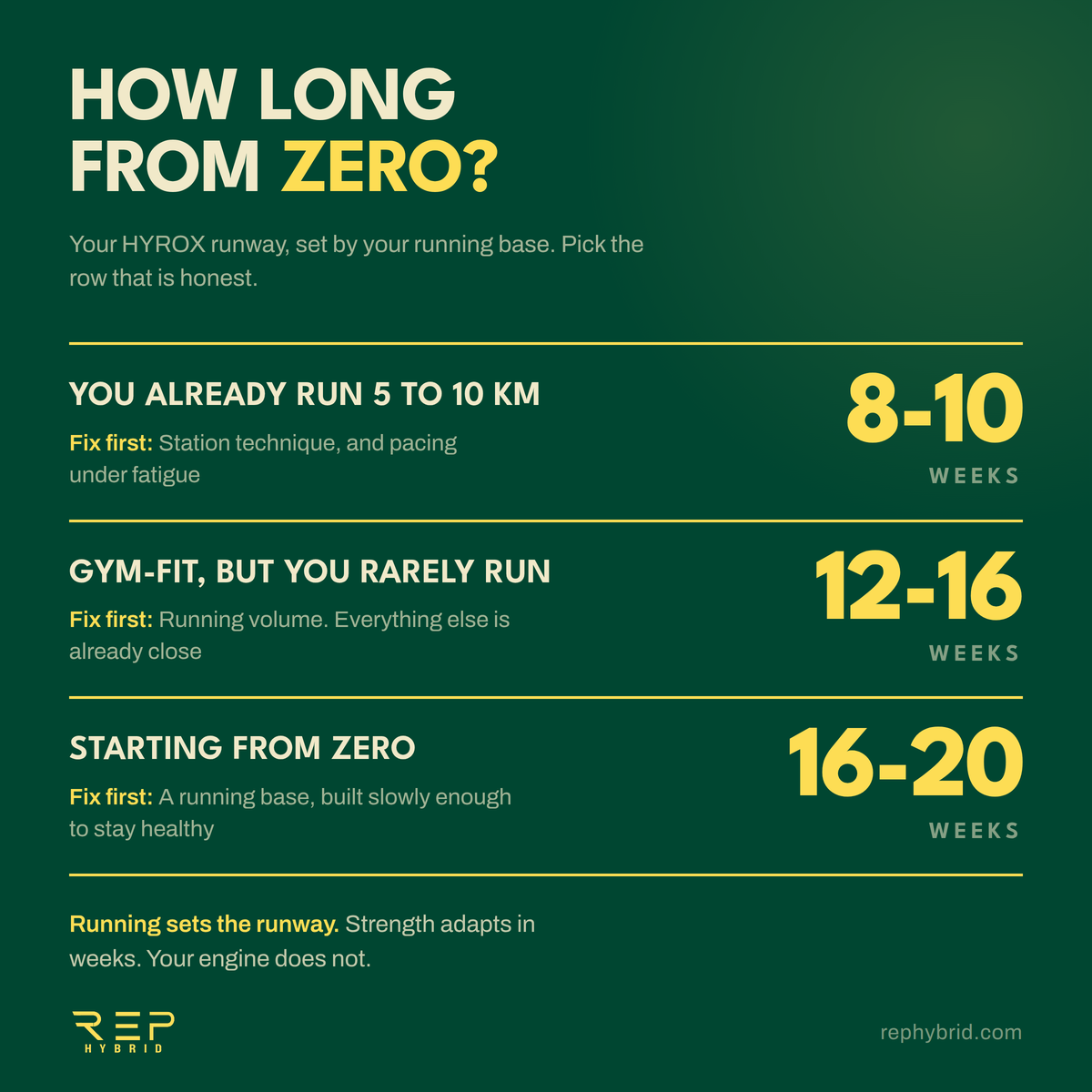
The middle row is where most people actually sit, and it is the one people get wrong most often. Being strong and being gym-fit feels like it should transfer. It transfers to the stations. It does not transfer to kilometre seven.
The bottom row is not a discouraging number. Sixteen weeks is four months, and trying to compress it is the most common way people end up injured instead of racing.
That is not a scare tactic either. A meta-analysis in Sports Medicine pooled the injury data across running populations and found novice runners get hurt at 17.8 injuries per 1000 hours of running, against 7.7 per 1000 hours for recreational runners. Beginners are basically injured at more than twice the rate per hour they run.
The runway is not there to be polite about your fitness. It is there because your tendons and connective tissue adapt slower than your enthusiasm does.
What a HYROX Training Plan Looks Like, Week to Week
Whatever your starting point, the shape of the block is roughly the same. What changes is how long you spend in each phase.
Weeks 1 to 4: Get the Runs In
The first month is mostly running, and it is the least glamorous part of the process. Two or three easy runs a week, at a pace where you could hold a conversation. Add one session that introduces the station movements at light load so the patterns become familiar.
Almost everyone runs too fast in this phase. The point is not to get fitter this week. The point is to accumulate enough running that your legs can handle the volume coming in month two, and to do it at the pace where the injury numbers above stay on your side.
By the end of week four you should be able to run five kilometres continuously without it being an event.
Weeks 5 to 8: Add the Stations
Now the work gets specific. Sleds, ergs, carries and wall balls go in properly, at loads that let you keep moving rather than loads that look impressive.
The key change is that you stop training running and stations separately. You start putting a run immediately after a station, then another station after that. This is where most of the actual adaptation happens, and it is where the training starts to feel like the race.
Expect this phase to be humbling. A sled push that felt easy on its own feels very different four hundred metres into the run that follows it.
Weeks 9 to 12: Put Them Together
The last block is about pacing and repetition. Full or partial simulations, in race order, on the clock. Not every week, because they are genuinely taxing, but often enough that race day is not the first time you have strung the whole thing together.
The goal of this phase is not to get fitter. It is to find out what pace you can actually hold, and to make that pace boring.
If you are on the sixteen or twenty week timeline, you are not adding a fourth phase. You are spending eight or ten weeks in phase one instead of four, because that is the part you cannot skip.
What a HYROX Training Week Looks Like at REP
Our three HYROX classes at Glo Damansara are built to cover the three jobs above without you having to write the programme yourself.
HYROX Engine is the long one, forty-five to sixty minutes of steady work. This is the base builder and the class almost everyone should start with. If you only train once or twice a week, make it this.
HYROX Sprint is sixty minutes broken into blocks, run fast and repeated. This is where the top end comes from, and it is what you add once the base is there rather than before.
HYROX Complete is ninety minutes at the weekend, stations and runs in race order, on the clock. This is the phase-three session. It is the closest thing to race day without paying an entry fee, and it is also the honest test of whether the week worked.
All three are coached and capped at thirty, and the loads and distances get scaled to you inside the group. A first-timer and someone chasing a podium can and do train the same session. The floor has two 12.5-metre sled lanes on turf, four standard HYROX sleds, Concept2 row, ski and bike ergs, curved treadmills and a 24-foot rig, so nothing in your training has to be approximated.
A reasonable week from zero looks like two Engine classes and one easy run of your own. A reasonable week eight weeks in looks like Engine, Sprint, and a Complete at the weekend.
You Do Not Have to Race at the End of It
Worth saying plainly, because it changes how you should read everything above.
Most people who train HYROX never enter a HYROX. The training is a complete, measurable fitness programme on its own: a real aerobic base, functional strength you can use, and a number that tells you whether you are improving. If you finish sixteen weeks fitter than you have ever been and never pin on a bib, the sixteen weeks still worked.
The deadline is useful because it makes you consistent, not because the medal matters. If a race in the calendar gets you to the gym on a Tuesday you did not feel like it, enter one. If it does not, train anyway.
Common Questions
How long does it take to train for HYROX if I have never run before?
Plan for sixteen to twenty weeks. The first eight to ten of those are mostly about building a running base at an easy pace, because that is the part that cannot be rushed without picking up an injury.
Is HYROX more about running or strength?
Running, at least when it comes to where you finish. Roughly half to 60 percent of total race time is spent running, and across a dataset of nearly 40,000 competitors, running was the discipline that tracked most closely with final position. Strength still matters, and it matters more the slower you are, because that is where less experienced athletes lose the most time.
Can a complete beginner train for HYROX?
Yes. Every load and distance scales down, so the session fits you rather than the other way round. What a beginner needs is not a different workout, it is a longer runway and a coach setting the loads.
How many times a week should I train for HYROX?
Two to four. Two is enough to make real progress from zero if one of them is a longer conditioning session. Four is about the ceiling before recovery, not effort, becomes the limiting factor.
Do I need to be able to run 8 km before I start?
No. Almost nobody can when they start, and building that capacity is what the training is for. You do want to be able to run five kilometres continuously before you enter a race.
Is HYROX harder than a 10 km run?
Different rather than harder. A 10 km run is one sustained effort. HYROX is eight sustained efforts interrupted by heavy work, at an average of around 170 beats per minute for well over an hour, which is why people with good 10 km times still find their first one a shock.
Where to Start
If you are starting from zero, start with HYROX Engine and give it a month before you judge anything. Add a run or two of your own on the days you are not here. Do not enter a race until you can run five kilometres without it being a project.
That is the whole plan. The rest is turning up.
If you want the full picture of the race itself, the eight stations in order and the weights at each one, that is all in our HYROX in Malaysia guide.
Start with the Intro Pack.
New here? A pack is the better way in, enough sessions to stop feeling new and start seeing what the training does. Or take a single class if you'd rather test the water.